
Learn about the scientific and reasonable dosage of Polikarboksilato superplastizatorius. Adjust the mixing amount according to raw materials, concrete grades and ambient temperature for stable slump performance.
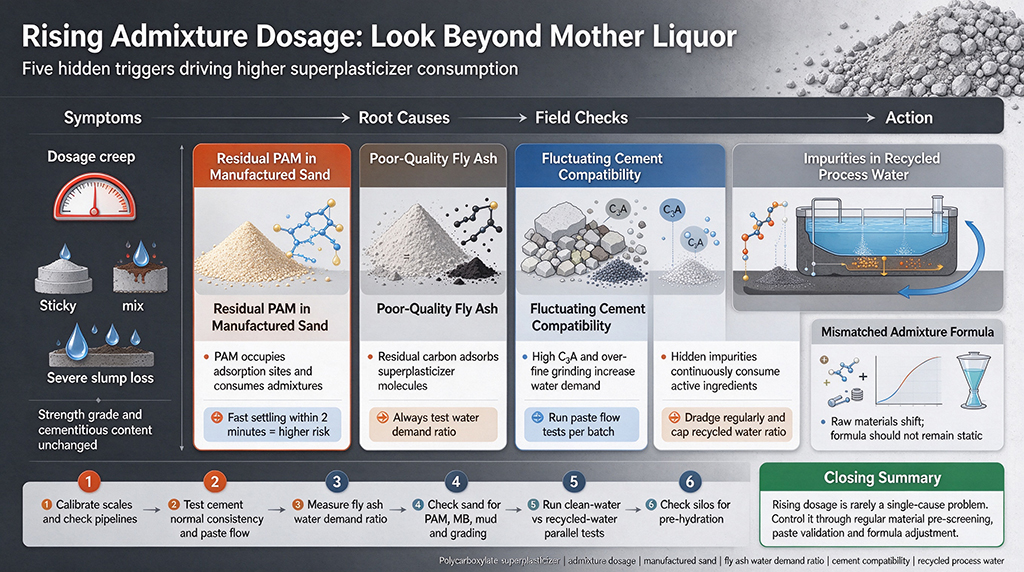
Overlooked Details Driving Higher Superplasticizer Consumption
Concrete batching plants face a common issue.
Strength grade and total cementitious content stay unchanged.
Admixture dosage creeps upward gradually.
Mix turns sticky and suffers severe slump loss.
Most teams first blame admixture suppliers.
Replacing suppliers fails to fix the trouble.
Root causes lie in raw materials and process gaps.
Missing routine tests also worsen this problem.
Polikarboksilato superplastizatorius reacts sensitively to impurities.
Strong adsorbing substances consume its active components.
Higher required dosage becomes the visible result.
Key Triggering Factors
Residual PAM flocculant in manufactured sand
Washed manufactured sand carries leftover PAM.
Qualified MB value cannot rule out residual PAM.
PAM seizes adsorption sites and consumes admixtures.
It also raises paste viscosity sharply.
Quick field check: Shake sand with added water.
Fast sedimentation within 2 minutes signals risks.
Solutions: Source cleaner sand or use anti-flocculant admixtures.
Reject heavily contaminated sand directly.
Do not raise dosage to cover this defect.
Poor-quality fly ash
Many inspect only loss on ignition and fineness.
They ignore the water demand ratio of fly ash.
Residual carbon adsorbs the superplasticizer molecules.
Field case: Cheap Class III fly ash cuts raw material cost.
Admixture dosage rises by 0.4–0.6%.
Total comprehensive production cost climbs instead.
Tip: Dark color does not equal unusable ash.
Always test its water demand ratio for validation.
Fluctuating compatibility of cement
The issue rarely comes from low-grade cement.
Cement mills adjust blended materials or grinding fineness.
High C₃A and over-fine grinding increase water demand.
Cement gains stronger adsorption on admixtures.
Many plants only test strength and soundness.
They skip normal consistency and paste fluidity tests.
Strength passes but compatibility deteriorates greatly.
Action: Run paste flow tests for every new cement batch.
Mismatched admixture formula against raw materials
Raw materials shift while formulas remain static.
Temperature changes demand adjusted retarder and slump-retaining parts.
Buyers chase low unit price and select low-solid admixtures.
Misconception: Higher mother liquor concentration cannot fix adsorption.
This move easily causes bleeding or excessive retarding.
Tweak components via trial mixes for changed raw materials.
Accumulated impurities in recycled process water
Settling tanks lack regular dredging or water replacement.
PAM and fine mud build up inside recycled water.
pH testing alone cannot reflect hidden impurities.
These contaminants keep consuming active admixture ingredients.
Dredge sediment on a fixed schedule.
Replace 1/3 to 1/4 water monthly with tap water.
Cap the maximum proportion of recycled mixing water.
Carry out parallel paste tests with clean and recycled water.
Other Compound Influencing Factors
Mud content, montmorillonite clay and stone powder hurt aggregates.
Poor aggregate gradation enlarges void space and paste viscosity.
Moist silos trigger pre-hydration of cement and slag powder.
Hot weather accelerates hydration and raises dosage demand.
Zero drift and pipeline residue reduce actual admixture delivery.
Operators increase dosage manually to compensate shortages.
Step-by-Step On-site Inspection Sequence (Simple First)
Calibrate weighing scales and inspect admixture pipeline residue.
Test cement normal consistency and paste flow against history data.
Measure fly ash water demand ratio and loss on ignition on site.
Do not fully trust inspection reports from material vendors.
Check sand for flocculant residue, MB value, mud and grading.
Run parallel paste trials using clean water and recycled water.
Separate raw material faults from formula defects via paste tests.
Check silos and confirm no pre-hydration of cementitious materials.
Closing Summary
Rising admixture dosage usually stems from combined factors.
Do not simply attribute all problems to admixture manufacturers.
Cement water demand, fly ash water demand ratio, residual flocculant in sand and impurities in recycled water act as four hidden consumption sources.
Cost control relies on pre-screening through regular material tests.
Avoid costly remedial work after dosage rises dramatically.