
Abstract
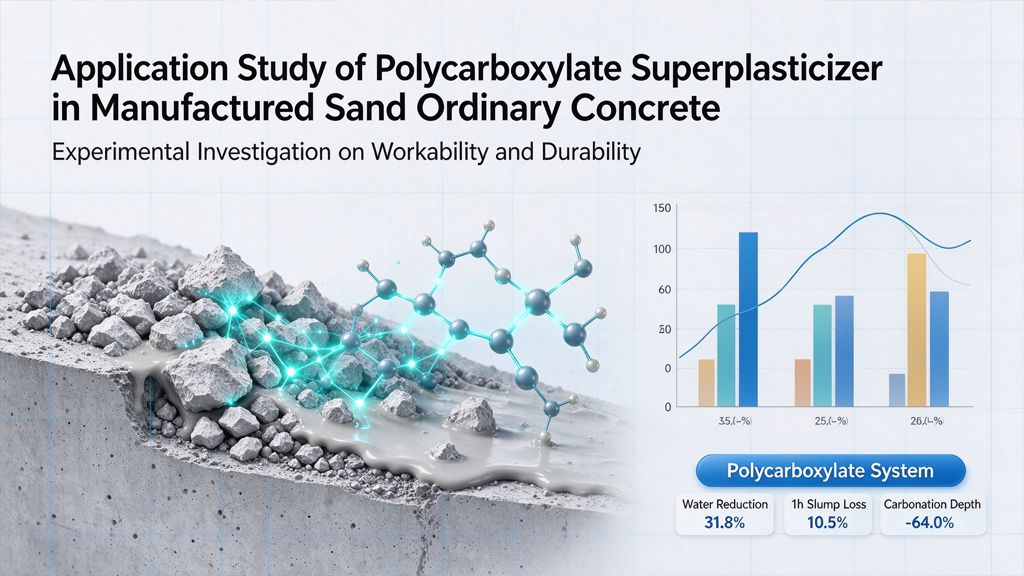
Concrete serves as a core material in building engineering, and its performance directly impacts structural safety and economic efficiency. Superplasticizers act as key chemical admixtures to improve its overall properties. Polycarboxylate superplasticizer demonstrates remarkable advantages in water-reduction rates and slump retention due to its unique molecular structure. Natural sand shortages have driven the widespread use of manufactured sand concrete, but its high stone powder content and rough surface texture often cause poor workability.
This paper investigates the effects of polycarboxylate superplasticizers on manufactured sand concrete while fixing the sand ratio at 44.56%. Furthermore, a comprehensive three-dimensional comparative analysis—spanning baseline, naphthalene-based, and polycarboxylate groups—is conducted to provide a scientific foundation for engineering applications.
1. Raw Materials
- Cement: Conch P.O 42.5R ordinary Portland cement was selected.
Table 1 Main Chemical Composition of Cement
| singa fototra | CaO | SiO₂ | Al₂O₃ | Fe₂O₃ | SO₃ | MgO |
| Content / % | 63.6 | 20.8 | 5.3 | 3.1 | 2.2 | 2.6 |
Table 2 Physical Properties of Cement
| zavatra | Water requirement for normal consistency / % | Initial setting time / min | Final setting time / min | 28d Compressive strength / MPa | 28d Flexural strength / MPa |
| Value | 27.0 | 165 | 220 | 51.6 | 8.6 |
- Aggregates: Continuous gradation limestone crushed stone (5mm to 25mm) served as coarse aggregate. Limestone manufactured sand meeting Class II standards served as fine aggregate.
- Polycarboxylate superplasticizer: An autonomously synthesized product with a 41% solid content and modified polyether side chains was applied to optimize stone powder dispersion. A naphthalene-based superplasticizer and a blank control group were established for comparative evaluation.
- Mixing water: Standard tap water complying with JGJ 63 regulations was utilized.
2. Experimental Methodology
- Mix design: The C30 manufactured sand concrete was designed with an optimized sand ratio of 44.56% to balance fluidity and cohesiveness.
- Test standards: Slump, slump retention, compressive strength, splitting tensile strength, and durability parameters were tested following standard national guidelines.
- Microscopic analysis: Scanning electron microscopy (SEM) and X-ray diffraction (XRD) were employed to analyze hydration products and microstructures.
3. Experimental Results and Analysis
Workability Performance
Polycarboxylate superplasticizers drastically improve mixture mobility. Specifically, a dosage of 0.22% achieves a water-reduction rate of 31.8%, significantly outperforming naphthalene-based alternatives. Moreover, the 1-hour slump loss rate drops sharply from 69.4% in the baseline group to only 10.5%, exhibiting exceptional fluidity retention.
Table 3 Effect of Polycarboxylate Superplasticizer on Workability of Manufactured Sand Concrete
| Type of superplasticizer | Dosage / % | Water consumption / (kg/m³) | Water reduction rate / % | Initial slump / mm | 1h slump / mm | Slump loss rate / % | Flow time / s | 1h flow time / s |
| Control group | 0 | 192 | 0 | 180 | 55 | 69.4 | 18 | 35 |
| Naphthalene-based superplasticizer | 1.20 | 162 | 15.6 | 185 | 115 | 37.8 | 15 | 28 |
| Polycarboxylate superplasticizer | 0.22 | 131 | 31.8 | 190 | 170 | 10.5 | 12 | 16 |
Mechanical Properties
The optimized compressive strength benefits greatly from enhanced mix densification and reduced porosity. At 7 and 28 days, concrete incorporating polycarboxylate superplasticizers displays compressive strength increases of 45.3% and 35.3%, respectively, alongside marked improvements in splitting tensile strength.
Table 4 Effect of Different Superplasticizers on Mechanical Properties of Concrete
| Type of superplasticizer | 7d Compressive strength / MPa | 28d Compressive strength / MPa | 7d Splitting tensile strength / MPa | 28d Splitting tensile strength / MPa |
| Control group | 21.2 | 30.6 | 2.08 | 2.55 |
| Naphthalene-based superplasticizer | 28.0 | 39.3 | 2.18 | 2.75 |
| Polycarboxylate superplasticizer | 30.8 | 41.4 | 2.61 | 3.25 |
Durability performance
The synergistic effect of high water reduction and optimal sand ratio refines the pore structure. Consequently, the concrete permeability resistance reaches $\ge P10$, freeze-thaw resistance achieves $\ge F200$, and carbonation depth decreases by 64.0%, substantially extending structural service life.
Table 5 Effect of Different Superplasticizers on Durability of Concrete
| Type of superplasticizer | Impermeability grade | Stable seepage pressure / MPa | Chloride ion diffusion coefficient / ( | Frost resistance grade | 200 freeze-thaw cycles Mass loss rate / % | 200 freeze-thaw cycles Relative dynamic modulus loss rate / % | 28d carbonation depth / mm | Reduction rate of carbonation depth / % | 28d internal pH value |
| Control group | ≤P6 | 0.58 | 2.6 | ≤F150 | 5.5 | 43.2 | 7.5 | / | 11.0 |
| Naphthalene-based superplasticizer | P8 | 0.78 | 1.8 | F180 | 4.9 | 39.0 | 4.8 | 36.0 | 11.4 |
| Polycarboxylate superplasticizer | ≥P10 | 1.02 | 1.1 | ≥F200 | 3.3 | 27.8 | 2.7 | 64.0 | 12.1 |
4. Engineering Case Application
Applied to the Donghua Town road widening project, the optimized C30 concrete mix ensured smooth pumping operations over high-temperature construction phases.
From an economic perspective, the material cost per cubic meter decreased by 10.7% compared to the baseline, construction efficiency rose by 161.3%, and 30-year maintenance expenses fell by 76.3%. Ecologically, carbon emissions dropped notably, supporting sustainable construction goals.
5. Fehiny
- Polycarboxylate superplasticizers effectively resolve workability challenges in manufactured sand concrete, achieving high water reduction and superior slump retention.
- Mechanical strengths and long-term durability metrics experience profound enhancements, minimizing micro-cracks and porosity.
- Field applications confirm outstanding technical and economic viability, making the technology highly recommended for widespread engineering promotion.