
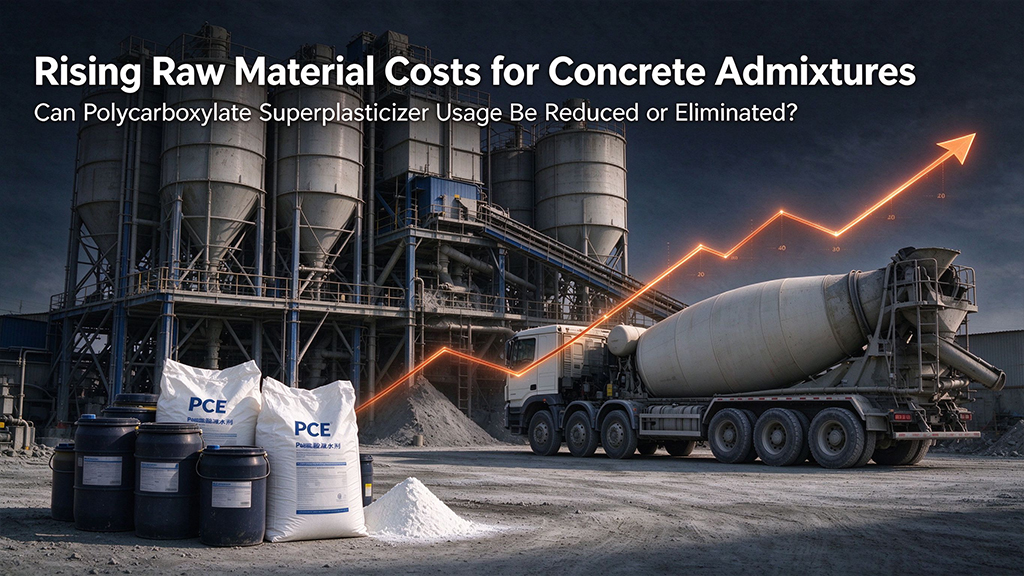
Raw materials for aditivos para concreto are rising sharply. Polyether monomers and acrylic acids are climbing, and production costs for superplastificante de policarboxilato (PCE) — the backbone of modern concrete admixtures — are jumping significantly.
Batching plants now face severe profit squeezes, and plant owners frequently ask technical teams a difficult question: Can we reduce or even eliminate admixture usage?
Small mixing stations often run without chemical admixtures, relying on manual mixing and low slumps. Large commercial plants, however, cannot simply copy this approach.
Pumping requirements dictate strict fluidity rules, and projects demand high slump retention for long-distance delivery. Yet the question remains: Can specific construction parts actually skip admixtures safely?
1. Why Small Stations Skip Admixtures
Small batching plants operate within short delivery radii. Trucks reach job sites within twenty minutes. Crews rarely use concrete pumps. Workers rely on manual vibration during placement.
Lower strength concrete grades achieve target standards easily. Plants increase cement content instead of using chemical agents. Higher cement consumption trades off against chemical costs.
Large plants face different operational pressures. Pumping concrete requires high workability and stability. Low slump mixes cause severe pipeline blockages. Pipeline failures generate massive financial losses.
Differentiation remains the key strategy. Non-pumped structural elements allow flexible admixture reduction.
2. Construction Parts That Can Reduce or Omit Admixtures
Certain concrete placements do not require high fluidity. Engineers can eliminate superplasticizers in specific zones.
- Mud Cushions and Sub-base Layers: These elements demand minimal workability. Stiff consistency mixes satisfy placement criteria entirely. Pumping mixes in cushions wastes chemical additives.
- Non-pumped Ground Slabs: Trucks discharge concrete directly into forms. High volumes of quality fly ash improve particle packing. Fly ash provides smooth ball-bearing lubrication naturally.
- Low-grade Backfill and Leveling Layers: C15 and C20 plain concrete need low slump control. Standard manual compaction finishes the job effectively.
Crucial Rule: Admixture-free mixes suit non-structural elements only. Main load-bearing frames always require high-performance superplastificante de policarboxilatos.
3. Technical Prerequisites for Reducing Admixtures
Removing chemical admixtures requires careful mix design adjustments. Labs must fulfill three strict technical conditions.
Optimize Mineral Powders
Class F fly ash introduces fine spherical particles. Ground granulated blast-furnace slag enhances later-stage density. Stable powder quality ensures consistent workability without chemical assistance.
Control Water-Cement Ratios
Eliminating superplasticizers never permits extra mixing water. Excess water destroys final compressive strength targets. Technicians must elevate cement content to maintain ratios.
Enhance Site Compuration and Curing
Stiff concrete mixtures demand rigorous mechanical vibration. Early moisture loss happens much faster. Crews must apply prompt wet curing methods.
4. Implementation Strategies for Large Batching Plants
Commercial mixing plants must protect pumping safety first. Plant managers should apply classified mix designs carefully.
Main structural beams and columns retain normal dosages. Foundation cushions and backfill zones adopt low-cost formulas. Production dispatchers must separate different loading tickets. Strict yard management prevents costly truck delivery errors.
5. Non-Negotiable Quality Bottom Lines
- Main structures and waterproof elements must retain admixtures.
- Every alternative mix needs rigorous laboratory trial testing.
- Technical teams must brief site contractors clearly beforehand.
Smart plants optimize costs through precision design. Eliminating waste protects profitability during material price surges.
Nossa equipe técnica profissional está disponível 24 horas por dia, 7 dias por semana, para resolver quaisquer problemas que você possa encontrar ao usar nossos produtos. Estamos ansiosos para sua cooperação!