
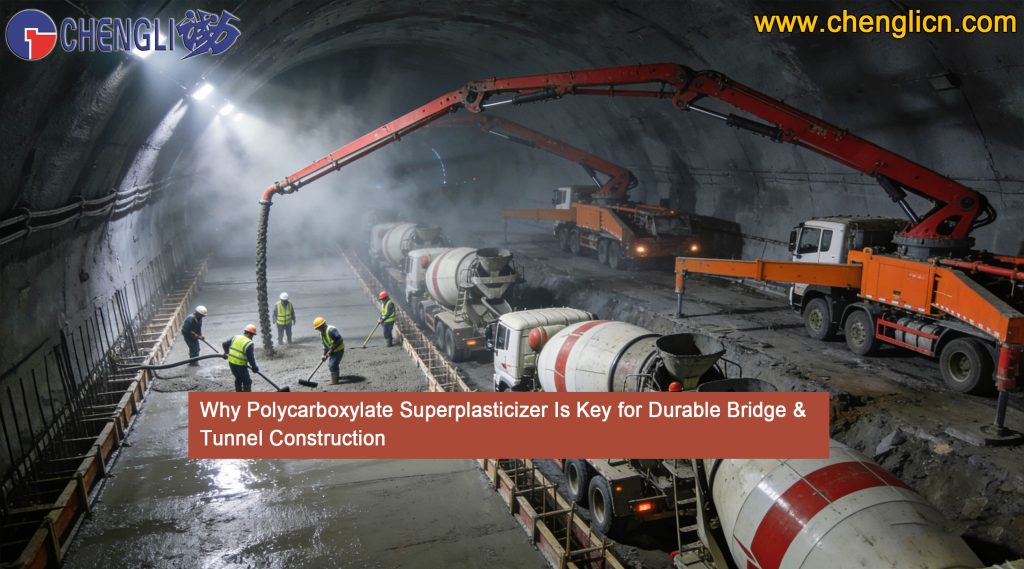
Bridges and tunnels stand as critical backbones of modern infrastructure. They endure harsh weather, heavy loads, and constant environmental stress daily. Engineers worldwide rely on advanced materials to extend their service life. Superplastifiant policarboxilat has emerged as a game-changer in this field. Its unique properties directly address the core durability challenges of bridge and tunnel construction.
Understanding PCE: The Foundation of High-Performance Concrete
Superplastifiant policarboxilat is a third-generation high-performance water reducer for concrete mixes. It features a comb-like molecular structure with anchoring main chains and hydrophilic side chains. This structure lets it attach to cement particles and disperse them evenly. Unlike traditional admixtures, it works efficiently at low dosages. A typical PCE dosage ranges from 0.35% to 0.93% of cement weight.
Its primary role is to reduce water content without sacrificing workability. This reduction minimizes concrete porosity and improves structural density. Experiments show PCE can cut water-cement ratios by up to 40% in bridge concrete mixes. A study with C50 concrete reduced the ratio from 0.4 to 0.32 using PCE. This change alone boosts durability by preventing water penetration and chemical erosion.
Experimental Data: How Superplastifiant policarboxilat Enhances Concrete Strength and Durability
Strength is the first line of defense for bridge and tunnel structures. A 2025 study tested concrete with varying PCE dosages (0.00%, 0.35%, 0.68%, 0.93%). At 28 days of curing, the 0.93% PCE mix achieved a 74% strength increase vs. the control group. This strength gain ensures bridges handle heavy truck loads and tunnels resist ground pressure.
Durability tests reveal even more impressive results. Electrical resistivity measures concrete’s ability to resist corrosion. The same 2025 study found 0.93% PCE increased surface resistivity by 177%. Higher resistivity means less chloride ion penetration from deicing salts. This protects steel reinforcement from rust, a top cause of bridge deterioration.
Tunnel construction faces unique challenges like high temperatures and water seepage. A 2025 tunnel water plugging test used 0.91% PCE in slurry mixes. At 90℃, the slurry achieved a gel time of 12 minutes and 21.35 MPa compressive strength in 3 days. It also had a low water separation rate of 2.87%, preventing water leakage in tunnels.
Slump flow, a key workability metric, improves significantly with Superplastifiant policarboxilat. Tests show PCE increases slump flow as dosage rises, though the rate slows at higher levels. For bridge piers, this means easier pouring into complex forms. For tunnels, it ensures smooth pumping through long hoses without clogs.
Superplastifiant policarboxilat vs. Traditional Admixtures: A Clear Advantage for Infrastructure
Traditional naphthalene-based superplasticizers once dominated the market. They offer a 15-25% water reduction rate, far less than PCE’s 25%+ rate. Superplastifiant policarboxilat also outperforms in slump retention, a critical factor for large projects. Ready-mixed concrete with PCE loses less than 15% slump in two hours.
Environmental impact matters in modern construction. Superplastifiant policarboxilat production uses no formaldehyde and releases no harmful substances. It is non-toxic, non-flammable, and easy to transport safely. Traditional admixtures often contain harmful chemicals that harm the environment over time.
Cost-effectiveness further solidifies Superplastifiant policarboxilat’s role. Its low dosage (0.35-0.93%) reduces material costs despite a higher unit price. A bridge project using 0.8% PCE cut cement usage by 10% while maintaining strength. This translates to significant savings for large-scale infrastructure projects.
Real-World Applications: PCE in Iconic Bridge and Tunnel Projects
China’s high-speed rail tunnels rely heavily on Superplastifiant policarboxilat for durability. The Guiyang tunnel project used PCE-optimized slurry to solve water seepage issues. It reduced construction time by 15% and improved long-term stability. Similar results appear in bridge projects like the Suzhou-Nantong Yangtze River Bridge.
In high-temperature tunnel projects, Superplastifiant policarboxilat ensures slurry performance remains consistent. The 90℃ test results prove it works reliably in extreme conditions. This makes it ideal for tunnels in hot climates or deep underground where temperatures rise.
Bridge decks benefit from Superplastifiant policarboxilat’s corrosion resistance. Deicing salts in cold regions often damage concrete and steel. PCE’s ability to reduce porosity cuts chloride penetration by 60% in test mixes. This extends deck service life by 15-20 years, reducing maintenance costs.
Conclusion: PCE as the Cornerstone of Durable Infrastructure
Superplastifiant policarboxilat is not just an admixture—it’s a durability solution. Its ability to reduce water content, boost strength, and resist corrosion addresses key infrastructure challenges. Experimental data consistently proves its superiority over traditional alternatives. From high-temperature tunnels to heavy-load bridges, Superplastifiant policarboxilat delivers reliable, long-lasting results.
As infrastructure demands grow, Superplastifiant policarboxilat will remain essential for building bridges and tunnels that stand the test of time. Its green properties, cost-effectiveness, and performance make it the top choice for engineers worldwide. For durable, efficient, and sustainable infrastructure, PCE is the key ingredient.
Echipa noastră tehnică profesionistă este disponibilă 24/7 pentru a rezolva orice probleme pe care le puteți întâlni în timpul utilizării produselor noastre.Așteptăm cu nerăbdare cooperarea dvs.!