
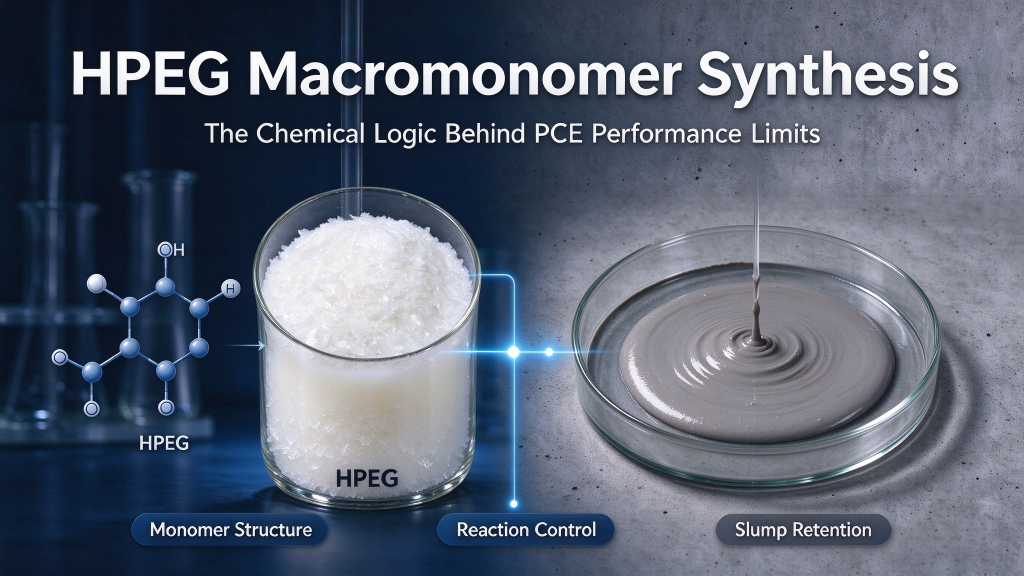
Modern high-performance concrete demands exceptional ingredients. Industry experts often credit HPEG macromonomer for unlocking the true potential of modern admixtures. Without this vital C4 macromonomer, achieving water reduction rates above 30 percent remains nearly impossible. Technicians call it the industry ceiling. Poor material quality ruins even the most meticulous laboratory formulas. Workers and engineers must understand how factories build this compound.
The Role of HPEG in Polycarboxylate Superplasticizers
Every Polycarboxylate Superplasticizer relies heavily on this raw material. Molecular structures determine how polymers behave inside concrete mixtures. Manufacturers engineer side chains using these specific ether molecules. Superior side chain grafting delivers maximum dispersion efficiency. Consequently, builders achieve high workability with less water.
Core Chemical Principle: Anionic Ring-Opening Polymerization
Production relies on precise chemical mechanics. Under alkaline conditions, initiators transform into active alkoxide structures carrying negative charges. These negative ions continuously open epoxide rings, driving graft polymerization forward. Chemists officially name this process anionic ring-opening polymerization. Industrial plants simply call the broader procedure an ethoxylation reaction.
The Eight-Step Industrial Synthesis Process
Factory floors follow strict protocols during synthesis. Each stage requires absolute precision to avoid catastrophic failures.
Step 1: Batching and Dehydration
Operators feed methylallyl alcohol and catalysts into a reaction vessel. Nitrogen purging removes residual oxygen completely. Vacuum dehydration follows, drying the mixture until water content drops below 0.05 percent. This humble preparation step dictates ultimate product success.
Step 2: Initiator Activation
Heaters raise vessel temperatures to 100 or 120 degrees Celsius. Targeted injection converts the initiator into active alkoxides while consuming active hydrogen traces. Controlled initial feeding prevents runaway reactions later.
Step 3: Ethoxylation Addition
Temperatures stabilize between 120 and 140 degrees Celsius under 0.3 to 0.5 megapascals of pressure. Metered ethylene oxide feeds continuously for three to seven hours. Massive heat generation poses the greatest operational hazard. External loop heat exchangers and heavy-duty agitators remove thermal energy constantly. Emergency shutdown systems protect the facility from thermal spikes.
Step 4: Maturation
Feed lines close after adding all ethylene oxide. Staff hold the temperature steady until internal pressure stops dropping. Complete conversion consumes all residual monomer. Thorough maturation eliminates safety hazards and yield losses.
Step 5: Neutralization
Acid addition neutralizes the alkaline catalysts effectively. Excessive residual alkalinity ruins downstream polymer synthesis later.
Step 6: Volatile Stripping
High-vacuum systems extract unwanted low-boiling impurities. Unreacted alcohols, aldehydes, and 1,4-dioxane disappear during this phase. Effective stripping safeguards environmental compliance and eliminates foul odors.
Step 7: Cooling and Flaking
Heated pipes transport molten liquid toward belt flakers. Liquid spreads evenly across moving stainless steel bands. Cold water spraying from beneath solidifies the polymer rapidly. Scraper blades peel off uniform flakes one to two millimeters thick. Solid flakes resist caking, eliminate dust, and dissolve faster than powders.
Step 8: Packaging and Storage
Handlers pack materials into twenty-five-kilogram woven bags or eight-hundred-kilogram bulk sacks. Inert gas sealing protects contents inside storage warehouses. Dark, dry environments prevent moisture absorption and slow oxidation. Users should consume opened bags within one week.
Critical Quality Indicators
Smart buyers look beyond basic specifications. Nominal molecular weights listed on certificates hide real variations. Experienced engineers prioritize the hydroxyl value over standard labels. Furthermore, maintaining high double bond retention guarantees optimal graft efficiency during polymerization. Low free polyethylene glycol content ensures high active component purity. Laboratory testing remains essential because theoretical calculations fail in real engineering scenarios.