
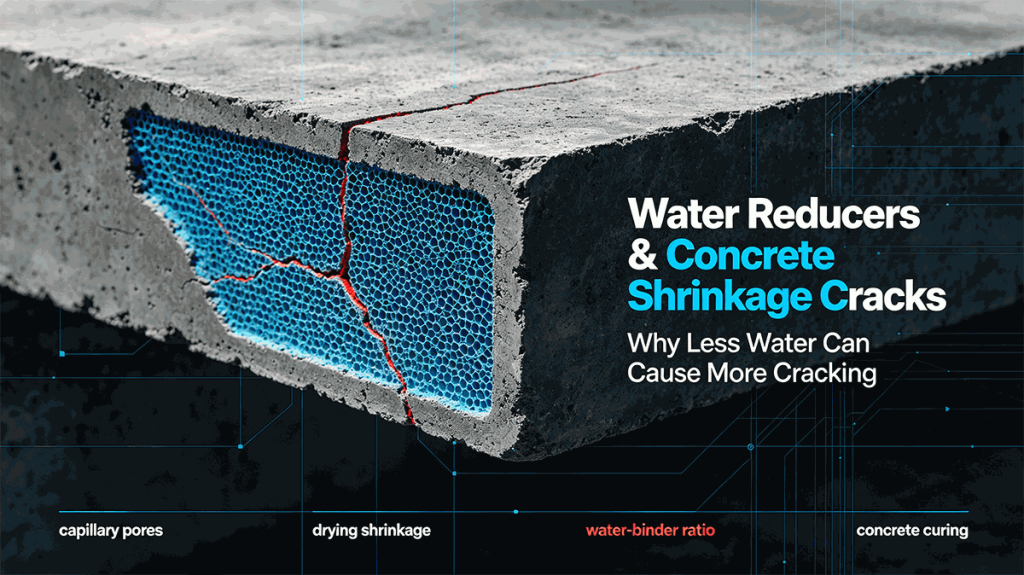
Learn why water reducers create extra concrete shrinkage cracks. Explore capillary pores, drying shrinkage, water-binder ratio and proper concrete curing for concrete projects.
Введение
Many field builders hit a confusing issue on concrete jobs. They use water reducers to cut mixing water and lower the water-binder ratio. Less mixing water appears to reduce drying shrinkage at first glance. Yet more concrete shrinkage cracks appear on finished concrete surfaces. This problem rarely comes from defective additives or wrong dosing. It ties closely to changes inside concrete capillary pores after mixing. Proper concrete curing can ease these unexpected cracking risks. Most construction crews rely on old assumptions about concrete performance. This article breaks down the real mechanism behind this counterintuitive phenomenon.
Common Logical Misconceptions About Concrete Cracking
Most builders hold a fixed view of concrete shrinkage and cracking. They believe water reducers disperse cement particles evenly in mixtures. Even water distribution cuts down the total mixing water volume effectively. Less internal water means less water evaporation during concrete hardening. Less evaporation should naturally reduce concrete shrinkage cracks significantly. This common reasoning sounds logical at first glance.
The first two steps of this logic are completely correct. The final judgment carries a critical technical error. Concrete drying shrinkage is not a simple water evaporation process. It relies on mechanical traction from negative pressure inside capillary pores. Hardened concrete fills with tiny interconnected capillary pores internally. Water evaporation in these pores creates stable negative pressure constantly.
The negative pressure pulls pore walls inward with steady force. Countless capillary pores generate simultaneous traction force internally. These tiny forces combine and cause overall concrete volume shrinkage. Concrete shrinkage degree does not only depend on evaporated water amount. It depends more on the negative pressure intensity of internal capillary pores.
Two Core Factors That Determine Concrete Shrinkage Strength
Two key factors control the negative pressure of concrete capillary pores directly. The first factor is the surface tension of mixing water. Lower water surface tension produces weaker evaporation negative pressure. Weaker pressure traction greatly eases overall concrete drying shrinkage. This principle supports the anti-cracking effect of professional shrinkage-reducing agents.
The second factor is the pore size of internal capillary structures. Basic physical laws govern capillary pressure changes strictly. Capillary negative pressure holds an inverse ratio to pore radius. Finer capillary pores create far stronger shrinkage traction force.
Water reducers deliver a vital structural optimization for concrete. They refine the rough internal pore structure of conventional concrete. They shrink ordinary micron-level pores into dense tiny holes. They rebuild the whole internal capillary system of hardened concrete thoroughly. This pore refinement changes concrete shrinkage performance fundamentally.
Counterintuitive Truth: Pore Refinement Dominates Shrinkage Effect
Adding water reducers triggers two opposite changes in concrete performance. Reduced mixing water relieves concrete drying shrinkage to a certain degree. Refined and denser capillary pores sharply raise internal shrinkage traction. These two effects offset each other in actual construction scenarios.
Pore refinement brings a far greater shrinkage increase. It completely overrides the shrinkage relief from reduced water usage. This balance explains worsening concrete shrinkage cracks with low water dosage. Water reducers show powerful pore optimization ability in practical use.
They upgrade micron-scale concrete pores to nanoscale delicate structures. One order of magnitude pore reduction boosts negative pressure exponentially. The pressure growth presents an explosive rising trend. Water reduction only creates linear and mild shrinkage relief. The exponential traction increase easily dominates the final shrinkage result.
Dual-Edged Nature of Water Reducers in Concrete Engineering
Water reducers act as a typical double-edged sword in concrete construction. They greatly improve concrete workability for smooth onsite operation. They lower the water-binder ratio to enhance final concrete strength. They help builders produce high-density and high-strength concrete materials.
Meanwhile, refined dense capillary pores bring hidden construction risks. These tiny pores generate strong lasting shrinkage traction during drying. The continuous traction force easily pulls concrete surfaces apart. It forms various fine and deep concrete shrinkage cracks over curing time. Good concrete curing slows pore water loss and controls shrinkage stress.
Заключение
Construction teams must abandon traditional empirical judgment. Low water consumption does not equal low cracking risks for modern concrete. Workers should focus on pore structure changes caused by water reducers. They need to match targeted concrete curing measures to offset pore shrinkage tension. Reasonable curing can effectively control concrete shrinkage cracks in low water-binder ratio concrete.