
Tillsatser, Rheology and High-Performance Concrete are closely interconnected topics in modern concrete research. Concrete has a history of more than 150 years. Nowadays, the global engineering community has raised doubts about its long-term service life, and durability has therefore become the focus of concrete research worldwide. In the past few decades, research efforts were mainly devoted to strength development. High-strength concrete has exceeded 100 MPa. Nevertheless, it is now recognized that the simple pursuit of high strength inevitably triggers a series of defects in other properties, among which brittleness is a tough challenge. Accumulated experience over 150 years has revealed that concrete engineering should not focus merely on strength; other performance indicators, especially durability, must also be taken into full consideration.
Why Admixtures, Rheology and High-Performance Concrete Matter for Durability
Against this background, the term High Performance Concrete emerged internationally. In fact, the connotation of high performance extends beyond its literal meaning. The core attributes of HPC include water resistance, resistance to chemical attack, permeability resistance, all of which are closely related to water. In effect, hydration cannot proceed without water, and concrete cannot form without hydration. Excess water severely degrades concrete quality, while insufficient water leaves abundant voids inside concrete, preventing the formation of a dense solid matrix and inhibiting strength gain. Accordingly, the preparation of high-strength and durable High Performance Concrete requires strict control over water dosage and shrinkage cracking.
Water dosage in concrete has thus become a key research priority for researchers. On the other hand, concrete undergoes hydration and hardening over time once mixed with water, binding aggregates such as sand and stone together and developing successive hardening properties. For this reason, concrete rheology has gradually become an indispensable discipline for concrete technology research.
Rheology Fundamentals and Fresh Concrete Rheological Parameters
First, the definition of rheology needs to be clarified. In short, rheology is the science of flow and deformation. Specifically, it is a branch of mechanics applicable to metallic, non-metallic, organic and inorganic materials. Different from conventional mechanics, which studies the motion of objects as rigid bodies without linking to internal microstructure and intrinsic properties, rheology investigates flow and deformation while correlating them with internal structural characteristics. Furthermore, rheology describes the time-dependent relationships between deformation and stress under external loading, as well as the evolution of elastic, viscous and plastic behaviours. Time dependence is a critical factor, and rheology aims to quantify the instantaneous stress–strain relationship under external loads.
Concrete is a composite material exhibiting combined elastic, viscous and plastic characteristics. As cement hydration proceeds, its viscous, plastic and elastic properties evolve continuously. From the moment dry raw materials are mixed with water and agitated, concrete transitions from a state dominated by viscoplasticity to one dominated by viscoelasticity. The former corresponds to the fresh concrete stage, and the latter to hardened concrete. Rheological research on concrete investigates the dynamics of visco-elastoplastic evolution and the influencing factors governing rheological behaviour, both for fresh and hardened states. Variations in physical and mechanical properties arising from structural evolution can be quantified by rheological parameters.
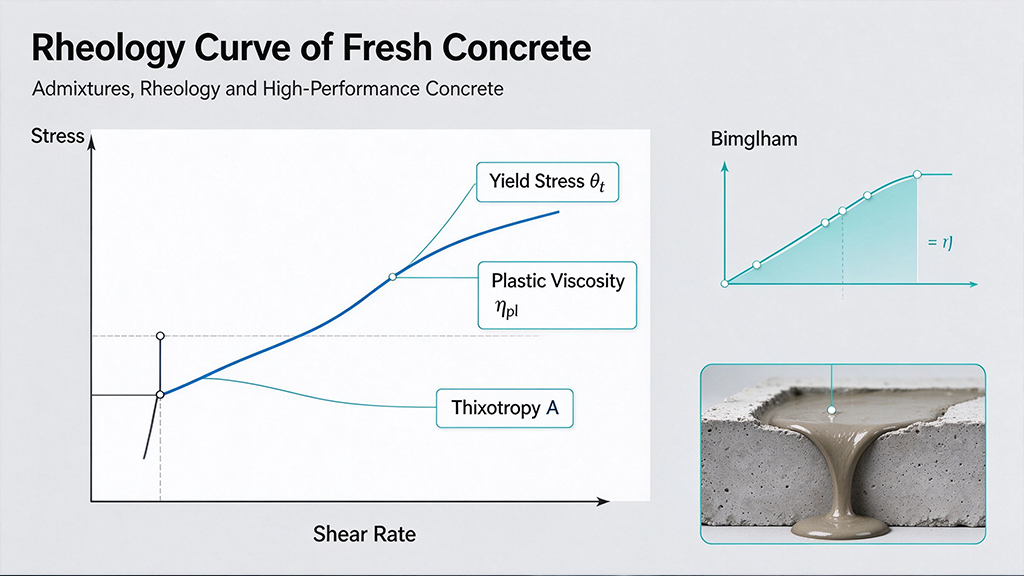
Therefore, rheological analysis enables comprehensive insight into the evolution of concrete before and after hardening, considering the synergistic effects of cement, water, sand and coarse aggregates. All features of hardened concrete, including pore structure, gel–space ratio, crack initiation and propagation, and microstructure formation, are determined by the rheological parameters of fresh concrete. Key rheological parameters of fresh concrete include yield stress (θₜ), plastic viscosity (ηₚₗ), thixotropy (A) and cohesiveness (C).
The suitability of water dosage is reflected by workability. Although extensive research has been carried out on its definition and measurement, a universally accepted definition and standard test method remain unavailable.
From the perspective of rheology, the author defines workability as follows: the degree to which a concrete mixture can achieve stability and compaction under a given energy input during mixing, transportation, casting, vibration and finishing. Under this definition, workability integrates four components: fluidity, plasticity, stability and compactability.
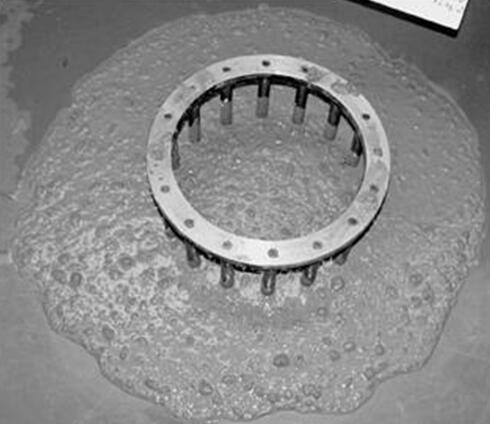
Common test methods for workability include the VB test, compacting factor test, flow table test and penetration test, all of which have inherent limitations. Recent studies propose the quantitative determination of yield stress and plastic viscosity via rotational viscometers based on the Bingham model, known as the two-point method, which delivers relatively satisfactory results. Since Abrams’ water–cement ratio theory, concrete research has advanced toward high strength. Although durability has been partially addressed, strength improvement remains the primary objective. Studies on high-strength concrete touch upon durability to some extent, yet durability is governed by more complicated factors and is far more difficult to control than strength.
The Role of Admixtures in Tuning Concrete Rheological Behaviour
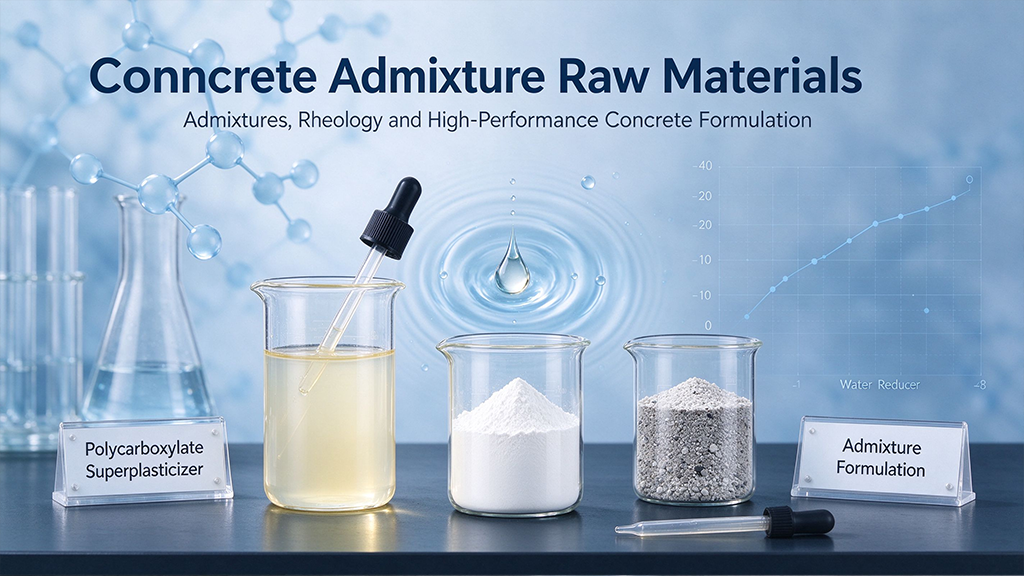
In recent years, betongtillsatser, particularly high-efficiency superplasticizers, have undergone rapid development. The advent of high-efficiency superplasticizers has lifted the maximum strength of concrete to unprecedented levels, fundamentally transforming structural design and marking a major technological breakthrough. Even so, high-strength concrete still faces considerable challenges to achieve both high strength and high durability. Many critical engineering structures demand performance beyond high strength alone.
Concrete research must commence at the fresh stage, namely the transition from viscoplastic fresh concrete to viscoelastic hardened concrete. Durability of hardened concrete should be considered from the outset, which is largely governed by the workability of fresh concrete. Nevertheless, water dosage alone cannot guarantee durability; resistance to chemical attack is equally vital, and compactability is a decisive factor for chemical resistance.
Tillsatser have become the sixth constituent of concrete. China accelerated the development of admixtures in the early 1980s, and they are now widely adopted in various engineering projects. During an inspection tour in the United States in the 1970s, the author found that the primary gap between China and the US lay in concrete admixtures. At that time, admixtures were widely applied across the United States to improve concrete durability, especially for highway construction, while admixture applications were rarely seen in domestic projects in China.
Admixtures can enhance multiple properties of concrete, including frost resistance, thermal stability, permeability resistance and strength, with remarkable effects at dosage levels of only a few per mille. In the early 1980s, the betongtillsats Committee was established under the China Civil Engineering Society, launching the development of this new discipline in China. To date, admixtures have been widely popularized domestically and deployed in numerous landmark projects to optimize concrete performance, among which superplasticizers, expansion agents and air-entraining agents are the most prevalent.
Subsequently, the China Concrete Admixture Association was founded, gathering hundreds of manufacturers and producing dozens of admixture categories. High-efficiency superplasticizers have achieved the broadest application, pushing the strength of domestic concrete above 100 MPa and making outstanding contributions.
✅【Polykarboxylat Superplasticizer】
If you want to know common field problems of PCE products, you can read our article: Polycarboxylate Superplasticizer Typical Problems and Countermeasures
Why are admixtures closely linked to the development of high-performance concrete? HPC cannot be realized without diverse admixtures. Air entrainment, impermeability, frost resistance and sulphate resistance all rely on tailored tillsatser.
Nevertheless, application methodology is critical. Dosage and addition timing significantly affect the final performance of admixtures and concrete workability. This explains why admixtures, rheology and high-performance concrete are inseparable in modern concrete formulation.
Development History & Classification of Concrete Admixtures
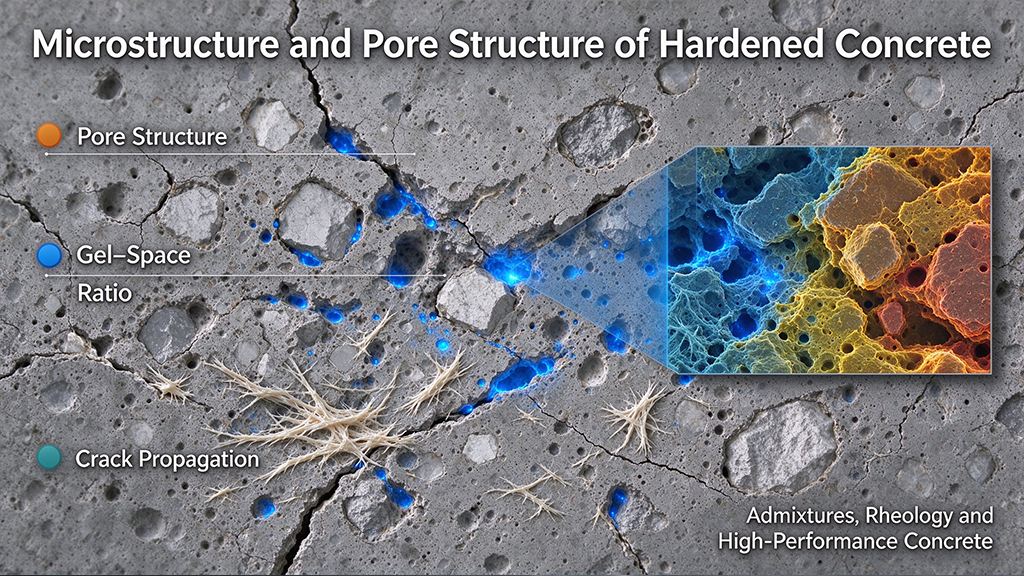
The development of High Performance Concrete represents the primary task of China’s concrete industry in the 21st century, with two core targets: ① favourable durability; ② resistance to various chemical aggressive agents in the service environment, and mitigation of volume changes induced by shrinkage and temperature fluctuation.
When discussing admixtures, air-entraining agents developed in the United States more than half a century ago deserve attention. At that time, highway pavements suffered severe cracking after each winter, shortening service life drastically. The introduction of air-entraining agents mitigated frost damage caused by hydraulic pressure from frozen pore water, greatly improving frost resistance and extending pavement service life. This technology fuelled the rapid expansion of the US highway network within a few years. Air-entraining agents have been adopted worldwide and remain one of the most effective frost-resistant admixtures.
High-efficiency superplasticizers have also gained global popularity in recent years and are widely used in China. They improve workability while reducing water demand, thereby substantially elevating concrete strength to record levels.
As mentioned above, High Performance Concrete requires enhanced water resistance and chemical resistance. Expansion agents have therefore emerged to compensate for concrete shrinkage, inhibiting water ingress through cracks and improving resistance to chemical attack and alkali–aggregate reaction.
Hundreds of concrete admixtures have been developed globally to satisfy HPC requirements. Characterized by ultra-low dosage and prominent efficacy, admixtures enjoy promising prospects and have been recognized as the sixth constituent of concrete.
To reduce cement consumption, finely ground mineral additives such as slag and fly ash are incorporated into concrete in various projects. Their main benefits include reduced cement demand, lowered water requirement, diminished volume deformation and decreased heat of hydration.
Key Engineering Practices for High-Performance Concrete

In summary, research on tillsatser, rheology and high-performance concrete guides the 21st-century development of concrete away from simple strength pursuit. 21st-century concrete will no longer pursue strength as the sole objective. It must achieve high strength, high durability and resistance to diverse natural destructive factors.
Developing high-performance concrete via admixtures and rheology appears to be the principal direction for the concrete industry in the 21st century. The author puts forward the following recommendations for 21st-century concrete:
① Research should not focus solely on strength gain; multi-performance synergy, especially durability, must be prioritized.
② High-performance concrete is the development trend of concrete structures, and its core value lies in superior durability.
③ Tillsatser, as the sixth constituent of concrete, require continuous innovation in varieties and functions.
The realization of high performance is theoretically inseparable from rheology. Special attention should be paid to the rheological parameters of fresh concrete, and admixtures serve as key modifiers adjusting these parameters. Accelerated development of new admixture varieties is required to meet the demands of high-performance concrete.
Future Trends: Admixtures, Rheology and High-Performance Concrete in 21st‑Century Construction
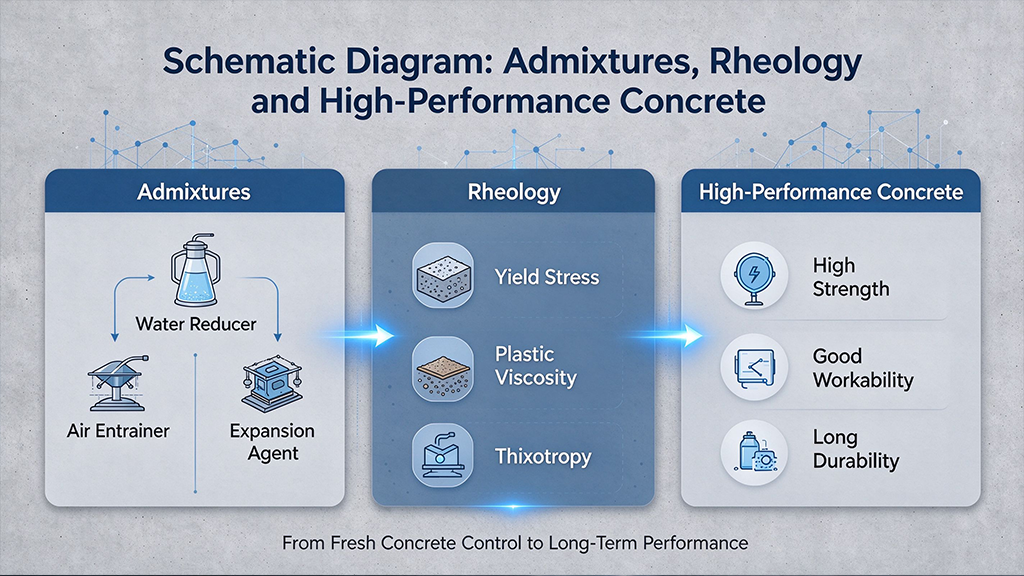
Continuous exploration of rheological regulation and new admixture systems will help engineers solve many long-standing bottlenecks in ready-mix, precast and ultra-high pumping concrete projects. Balancing strength, flowability and long-term durability will remain the core pursuit of modern concrete technology.